Hey guys, Traffic Insider here, and if you’re reading this, you’re looking to make one of the most important tech decisions of 2026. The smartphone landscape is always evolving, but this year, the battle for supremacy at the very top is more intense than ever. We’re talking about the titans, the undisputed kings of the mobile world: Apple’s highly anticipated iPhone 17 and Samsung’s powerhouse Galaxy S26. These aren’t just phones; they’re technological statements, lifestyle hubs, and your window to the future.
As your trusted guide, I’ve delved deep into the expected, the rumored, and the absolutely groundbreaking innovations that both companies are bringing to the table. Forget last year’s models; we’re breaking down the precise technical specifications, absolute feature comparisons, and the nitty-gritty details you need to decide which flagship smartphone truly deserves your hard-earned money in 2026. Let’s jump into the future!
The Battle Royale of 2026: iPhone 17 vs. Samsung S26
The iPhone 17 and Samsung S26 represent the pinnacle of mobile engineering. Both promise unparalleled performance, revolutionary camera systems, and deeply integrated AI experiences. But while they share a common goal of excellence, their approaches, ecosystems, and philosophies remain distinctly different. Understanding these nuances is key to making the right choice for *you*.
Design & Display: A Visual Feast
In 2026, design language has matured, with both companies focusing on refined ergonomics and maximized screen real estate. The iPhone 17 Pro Max is expected to feature an even more durable, aerospace-grade titanium chassis, perhaps with a slightly curved edge profile for enhanced grip. Apple’s display will likely be the ProMotion XDR 4.0, pushing peak brightness to an astonishing 3200 nits and boasting a truly adaptive refresh rate that can scale from 0.5Hz for always-on display to 144Hz for buttery-smooth gaming. We anticipate the Dynamic Island evolving further, with most Face ID components now subtly integrated under the display, leaving only a minuscule, nearly invisible punch-hole for the front camera.
Samsung’s Galaxy S26 Ultra will counter with its signature Armor Aluminum 4.0 frame and a stunning Dynamic AMOLED 4.0 XDR display. Samsung has perfected its Under-Display Camera (UDC) technology; the S26 Ultra will offer a truly uninterrupted, bezel-less viewing experience, making the front camera practically invisible. Expect peak brightness to hit an industry-leading 3500 nits, with a variable refresh rate from 1Hz to 160Hz. Both devices will feature strengthened Ceramic Shield (iPhone) and Gorilla Glass Victus 3 (Samsung) for ultimate durability.
- iPhone 17 Design & Display Pros:
- Exceptional color accuracy and calibration.
- Robust build with advanced titanium and Ceramic Shield.
- Evolved, less obtrusive Dynamic Island (or near full UDC for Face ID).
- iPhone 17 Design & Display Cons:
- Potentially slightly lower peak brightness compared to S26 Ultra.
- Samsung S26 Design & Display Pros:
- True full-screen experience with perfected UDC.
- Industry-leading peak brightness and wider color gamut.
- Refined S Pen integration (Ultra model).
- Samsung S26 Design & Display Cons:
- Some users might prefer physical buttons or a visible camera cutout for clarity.
Performance & AI: Powering the Future
This is where the rubber meets the road. The iPhone 17 Pro and Pro Max will be powered by Apple’s new A19 Bionic chip, built on a cutting-edge 2nm process. This SoC (System-on-Chip) will feature an exponentially more powerful Neural Engine, capable of trillions of operations per second, making on-device AI faster and more efficient than ever before. Expect unparalleled raw CPU and GPU performance, delivering desktop-class gaming and seamless professional video editing directly on your device. The focus will be on AI-driven efficiency, real-time computational photography, and next-gen AR applications.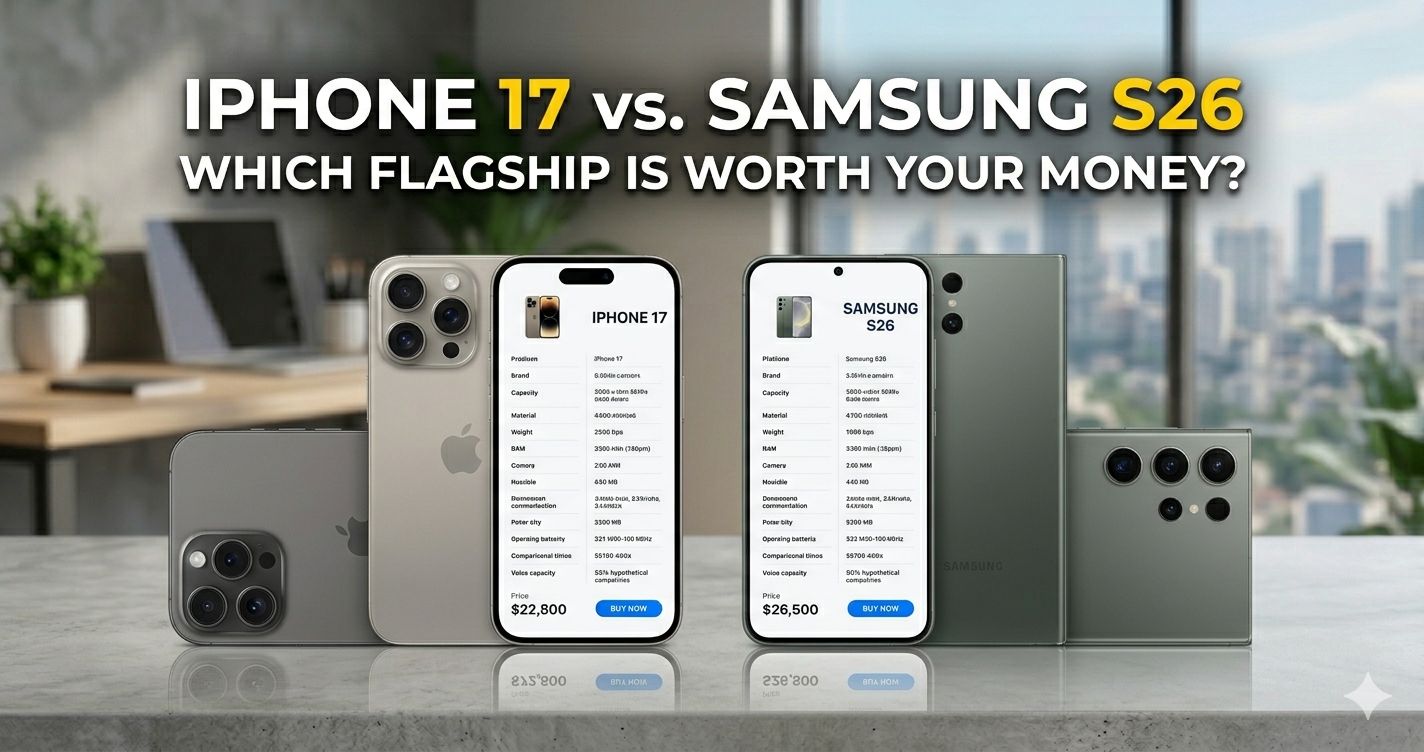
Samsung’s Galaxy S26 Ultra will likely pack the Snapdragon 8 Gen 5 for Galaxy (or the equally formidable Exynos 2600 in some regions), also manufactured on an advanced 2nm process. Qualcomm’s latest NPU will be a beast, driving Samsung’s enhanced Galaxy AI 2.0 features, from real-time language translation to advanced image generation and predictive multitasking. With up to 16GB of LPDDR6 RAM, the S26 Ultra will be a multitasking champion, handling demanding applications and Dex desktop mode with effortless grace.
- iPhone 17 Performance & AI Pros:
- Industry-leading single-core and multi-core CPU performance.
- Optimized software-hardware integration for peak efficiency.
- Unrivaled Neural Engine for on-device AI.
- iPhone 17 Performance & AI Cons:
- Less accessible RAM specifications.
- Samsung S26 Performance & AI Pros:
- Top-tier multi-core performance and exceptional NPU.
- Up to 16GB RAM for superior multitasking.
- Advanced Galaxy AI 2.0 with groundbreaking features.
- Samsung S26 Performance & AI Cons:
- Potential regional chip discrepancies (Snapdragon vs. Exynos).
Camera Systems: Photography Redefined
The camera battle in 2026 is no longer just about megapixels, but computational intelligence. The iPhone 17 Pro Max will feature a triple-lens system with a significant sensor size increase for its main 60MP camera. Expect a new generation of Apple’s Photonic Engine 3.0, offering unprecedented low-light performance, real-time subject tracking, and AI-powered semantic editing. The ultra-wide lens will likely be 18MP with improved macro capabilities, and the telephoto will be a second-generation tetraprism periscope lens, offering 7x optical zoom and up to 50x digital zoom. Video recording will reach 8K ProRes at 30fps, with advanced cinematic mode features and even more robust stabilization.
The Samsung Galaxy S26 Ultra will push the boundaries further with a quad-camera setup led by a colossal 250MP main sensor, utilizing advanced pixel-binning technology for incredible detail and light capture. Its second-gen periscope telephoto lens could offer a staggering 15x optical zoom and 150x Space Zoom, complemented by a dedicated 10MP 3x optical telephoto for versatile portraiture. The ultra-wide will be a 50MP sensor with autofocus and enhanced Nightography 3.0. Samsung’s AI will be heavily involved in image processing, offering generative fill, advanced object removal, and intelligent scene optimization. 8K video at 60fps with advanced stabilization and new director modes will be standard.
- iPhone 17 Camera Pros:
- Unrivaled computational photography and color science.
- Exceptional video recording capabilities (ProRes, Cinematic Mode).
- Consistent, high-quality results across all lenses.
- iPhone 17 Camera Cons:
- Lower raw megapixel count compared to Samsung.
- Samsung S26 Camera Pros:
- Groundbreaking 250MP main sensor for incredible detail.
- Industry-leading optical zoom capabilities.
- Versatile quad-camera setup with extensive AI features.
- Samsung S26 Camera Cons:
- Image processing can sometimes be overly aggressive.
Battery Life & Charging: Endurance Meets Speed
Battery life remains a critical factor for any flagship smartphone. The iPhone 17 Pro Max is expected to house a larger battery, perhaps around 5500 mAh, combined with the extreme efficiency of the A19 Bionic chip and iOS 20 optimizations, promising easily over two days of mixed usage. Charging speeds will likely improve to 45W wired and 25W MagSafe 3.0 wireless, with enhanced reverse wireless charging for accessories.
The Samsung Galaxy S26 Ultra will likely push the battery capacity even higher, possibly reaching 6000 mAh. Paired with the efficient Snapdragon 8 Gen 5 and One UI 9.0 optimizations, it could offer similar or even slightly better endurance. Where Samsung truly shines is charging speed: expect 120W wired charging, capable of a full charge in under 20 minutes, alongside faster 50W wireless charging and robust reverse wireless charging capabilities.
- iPhone 17 Battery & Charging Pros:
- Exceptional software-hardware optimization for long battery life.
- Reliable and efficient MagSafe ecosystem.
- iPhone 17 Battery & Charging Cons:
- Slower wired charging speeds compared to Samsung.
- Samsung S26 Battery & Charging Pros:
- Potentially larger raw battery capacity.
- Blazing-fast 120W wired charging.
- Faster wireless charging speeds.
- Samsung S26 Battery & Charging Cons:
- High charging speeds might generate more heat over time.
Software Experience: iOS 20 vs. One UI 9.0
The operating system defines much of your daily interaction. iOS 20 on the iPhone 17 will be a masterclass in elegant simplicity and deep ecosystem integration. Expect advanced on-device AI features for Siri, enhanced privacy controls, more customizable Lock Screen and Home Screen widgets, and even more seamless continuity features across your Apple devices (Mac, iPad, Apple Watch, Vision Pro). The focus remains on intuitive user experience and robust security.
One UI 9.0, built on Android 16, running on the Samsung S26, will offer unparalleled customization and flexibility. Samsung’s Galaxy AI 2.0 will be deeply integrated into the OS, offering features like advanced generative AI for image editing, intelligent content summarization, and predictive system optimization. DeX mode will be further refined, offering a true desktop experience when connected to a monitor. The openness of Android, combined with Samsung’s extensive feature set, caters to users who demand control and versatility.
- iPhone 17 Software Pros:
- Unmatched ecosystem integration and continuity.
- Industry-leading privacy and security features.
- Smooth, intuitive, and consistent user experience.
- iPhone 17 Software Cons:
- Less customization freedom compared to Android.
- Samsung S26 Software Pros:
- Extensive customization options and Android flexibility.
- Powerful Galaxy AI 2.0 with practical applications.
- Enhanced DeX mode for desktop-like productivity.
- Samsung S26 Software Cons:
- Can sometimes feel more complex for new users.
Key Specifications at a Glance: 2026 Flagship Comparison
Here’s a quick summary of the expected, cutting-edge specifications for the iPhone 17 Pro Max and Samsung Galaxy S26 Ultra in 2026:
| Feature | iPhone 17 Pro Max (2026) | Samsung Galaxy S26 Ultra (2026) |
|---|---|---|
| Processor | Apple A19 Bionic (2nm) | Snapdragon 8 Gen 5 for Galaxy / Exynos 2600 (2nm) |
| Display | ProMotion XDR 4.0, 6.9″ OLED, 0.5-144Hz, 3200 nits peak, Micro-Dynamic Island | Dynamic AMOLED 4.0 XDR, 6.9″ OLED, 1-160Hz, 3500 nits peak, Perfected UDC |
| Main Camera | 60MP (OIS), Photonic Engine 3.0 | 250MP (OIS, Pixel Binning) |
| Telephoto | 2nd-gen Tetraprism (7x Optical) | 15x Optical Periscope + 3x Optical Portrait |
| Ultra-Wide | 18MP (Autofocus, Macro) | 50MP (Autofocus, Macro) |
| Video Recording | 8K ProRes 30fps, Cinematic Mode 3.0 | 8K 60fps, Director’s View 2.0 |
| Battery Capacity | ~5500 mAh | ~6000 mAh |
| Wired Charging | 45W | 120W |
| Wireless Charging | 25W MagSafe 3.0 | 50W Qi2 enhanced |
| RAM | 8-10GB (Expected) | 12GB / 16GB |
| Storage (Base) | 256GB | 256GB |
| Connectivity | Wi-Fi 7, Bluetooth 5.5, Satellite SOS Pro, USB-C 4.0 (Thunderbolt 5) | Wi-Fi 7, Bluetooth 5.5, Enhanced Satellite, USB-C 4.0 |
| OS | iOS 20 | One UI 9.0 (Android 16) |
The Final Buyer Verdict: Which Flagship is Worth YOUR Money in 2026?
Choosing between the iPhone 17 and the Samsung S26 in 2026 is not about identifying a “better” phone, but the “right” phone for your specific needs and ecosystem. Both devices are monumental achievements, pushing the boundaries of what’s possible in a handheld form factor.
- You should buy the iPhone 17 if:
- You prioritize an intuitive, deeply integrated ecosystem with other Apple products.
- You value unparalleled software-hardware optimization and long-term support.
- You demand top-tier video recording and consistent, natural photographic output.
- You appreciate streamlined simplicity and best-in-class privacy.
- You should buy the Samsung Galaxy S26 if:
- You crave ultimate flexibility, customization, and open-ended possibilities with Android.
- You want the most advanced camera hardware, particularly for extreme zoom and raw megapixel detail.
- You require blazing-fast charging speeds and a potentially larger battery.
- You leverage the S Pen (on Ultra models) for productivity and creativity, or desire a truly uninterrupted full-screen display.
In 2026, both the iPhone 17 and Samsung S26 will represent peak innovation. The iPhone 17 will deliver a meticulously refined, powerfully integrated, and effortlessly premium experience, making it the perfect choice for those embedded in the Apple ecosystem or seeking a seamless, robust device. The Samsung Galaxy S26, particularly the Ultra model, will be the bleeding edge of hardware, offering a feature-rich, customizable, and technologically audacious experience for power users and Android enthusiasts. Whichever you choose, you’re investing in a device that will define the next generation of mobile computing. Make your decision wisely, and let me know in the comments below which one you’re leaning towards!
Frequently Asked Questions (FAQ)
Will the iPhone 17 finally have an Under-Display Camera (UDC)?
While Apple is known for its cautious approach to new display technologies, we anticipate the iPhone 17 Pro Max in 2026 will feature a significantly reduced Dynamic Island, with most Face ID components moving under the display, potentially leaving only a microscopic punch-hole for the camera, or a fully functional UDC for the entire system, offering an almost bezel-less experience. A full UDC for the camera is less certain for 2026, but under-display Face ID is highly probable.
What new AI features can I expect from the Samsung S26’s Galaxy AI 2.0?
Samsung’s Galaxy AI 2.0 on the S26 is expected to be a substantial upgrade. Features could include advanced on-device generative AI for real-time photo and video editing (e.g., changing weather in a video, generating background elements), predictive text and context-aware suggestions across the entire OS, intelligent call screening with personalized AI voices, and deeper integration with productivity tools like DeX for AI-powered summarization of documents or meetings.
Which phone will offer better battery life in 2026?
Both devices are expected to offer excellent battery life due to efficient processors and optimized software. The iPhone 17 Pro Max, with its highly efficient A19 Bionic chip and iOS 20, will likely offer impressive endurance. However, the Samsung S26 Ultra might come with a larger raw battery capacity (potentially 6000mAh), which, combined with the efficient Snapdragon 8 Gen 5, could give it a slight edge in overall uptime for heavy users. Apple’s optimization tends to lead to superior standby time.
Will both the iPhone 17 and Samsung S26 support satellite connectivity?
Yes, by 2026, enhanced satellite connectivity features are expected to be standard on both flagships. While initial implementations focused on emergency SOS, the 2026 versions are likely to support more robust two-way messaging, and potentially even limited data transfer in remote areas, making them invaluable for safety and connectivity beyond traditional networks.
Written by Traffic Insider
Official editorial intelligence team. We monitor, cross-verify, and publish high-utility reviews, guides, job alerts, and scheme parameters under strict factual verification guidelines.